
Introduction
On April 28, 2026, FDA announced that two clinical trials are now reporting endpoints and data signals to the agency in real time. AstraZeneca's TRAVERSE study in mantle cell lymphoma and Amgen's STREAM-SCLC study in small cell lung cancer are transmitting live data feeds to FDA reviewers through a cloud-based pipeline. FDA has already received and validated real-time data from TRAVERSE. The agency simultaneously published a Request for Information on a broader pilot program, with final selection criteria planned for July and pilot selections in August.
This is not a conceptual framework or a future-state roadmap. It is an operational program with working data pipelines and a defined expansion timeline.
Commissioner Makary described the initiative in terms of eliminating the lag time between data generation at sites, consolidation at sponsors, and submission to FDA. Chief AI Officer Jeremy Walsh estimated the approach could reduce overall trial duration by 20 to 40 percent. The ambition, as stated, is to eventually eliminate the phase-to-phase hiatuses that structure conventional drug development and move toward continuous trials.
What is receiving less attention than the headline numbers is what the initiative actually requires from the systems running the trial.
What Real-Time Review Changes About the Data Flow
The conventional clinical trial data flow operates in batch. Sites collect data at scheduled visits. Data is transmitted to sponsors on a periodic basis, often weekly or biweekly. Sponsors clean, query, and validate that data in cycles that may run for weeks. Periodically, cleaned data is submitted to FDA in the context of formal regulatory interactions: INDs, safety reports, interim analyses, and ultimately the final dataset at study completion.
This batch model was designed for a world where the transmission and processing of large datasets required significant lead time. It also created a structural separation between the trial's operational record and FDA's view of the evidence: what FDA saw was a cleaned, curated snapshot of data generated weeks or months earlier.
The real-time clinical trials initiative inverts that model. FDA is not waiting for a curated submission. It is observing a live data feed. That means the data reaching FDA must be clean, structured, and protocol-faithful at the point it is generated, not after a reconciliation cycle.
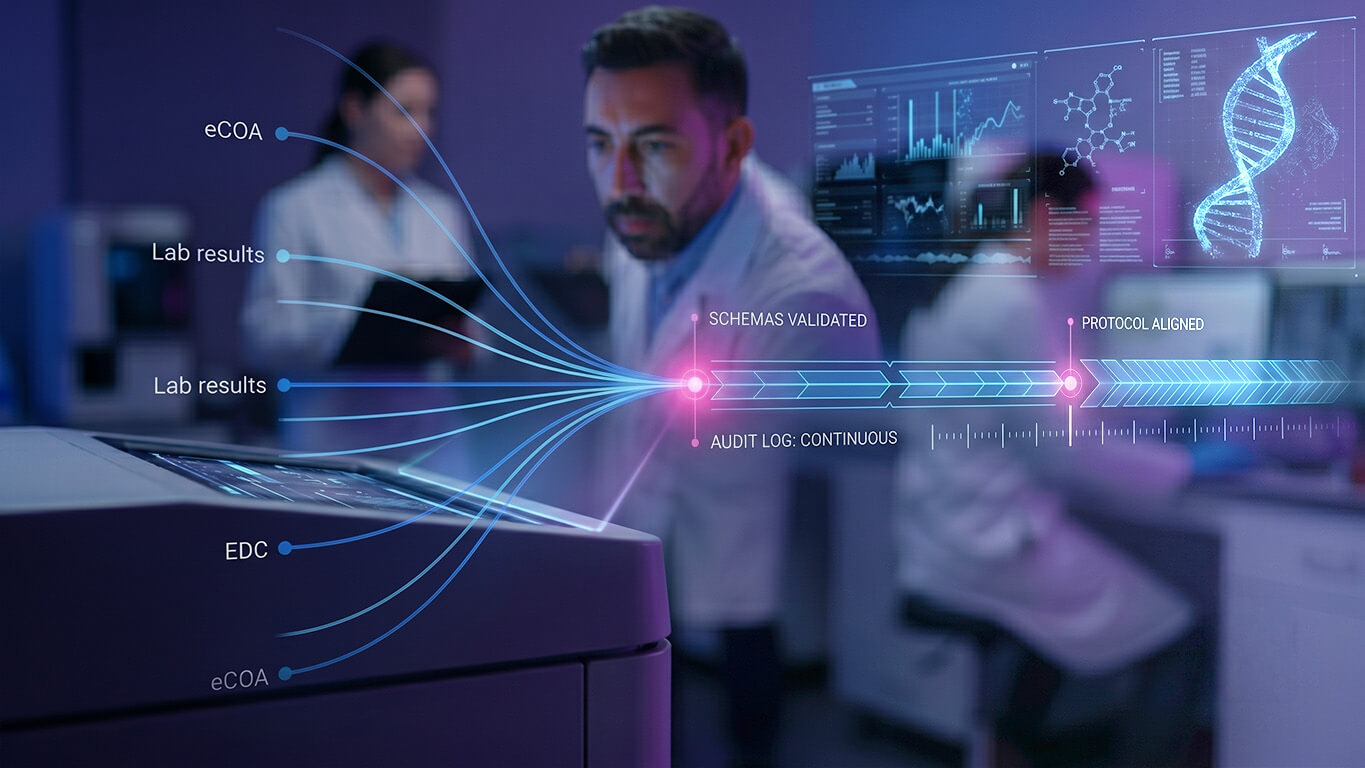
The TRAVERSE and STREAM-SCLC pipelines carry typed clinical fields with defined schemas, audit logs, and sponsor sign-off. The data architecture is not an afterthought. It is the core requirement. A trial whose data is collected in free-text fields, reconciled manually across vendor systems, and cleaned in batch cycles cannot support a real-time data feed. The infrastructure that makes real-time review possible is the infrastructure that produces structured, validated data at the point of capture.
The Infrastructure Gap the Initiative Exposes
Most clinical trials running today are not built on infrastructure that could satisfy a real-time data feed requirement without substantial modification.
The standard architecture for a Phase 2 clinical trial involves an electronic data capture system for case report forms, a separate eCOA platform for patient-reported and clinician-administered outcome instruments, a central laboratory system for safety and efficacy biomarkers, an IRT system for randomization and drug supply, and a safety reporting platform for adverse event management. Each of these systems operates on its own data model, its own transmission schedule, and its own validation logic.
The data that arrives at the sponsor from these systems is asynchronous: laboratory results arrive on one schedule, eCOA data on another, visit data on a third. Reconciliation across these systems is typically a manual process, conducted by a data management team working against a timeline defined by the study's cleaning milestones.
This architecture cannot produce a real-time data feed to FDA because it does not produce a real-time data feed internally. The sponsor's own view of the trial's current state is typically days to weeks behind the events that have occurred at sites. A real-time feed to FDA requires a real-time data layer at the sponsor level first.
What the RFI's data architecture requirements reflect, with their specification of typed clinical fields, known schemas, and audit logs, is the set of properties that a system must have to support continuous data validation rather than batch validation. A field with a defined type and a known schema can be validated at the moment it is entered. An audit log attached to every event means the provenance of every data point is traceable from the moment of capture. These are not characteristics of the data that is cleaned and submitted at the end of a trial. They are characteristics of the platform that generates the data throughout the trial.
What the Pilot Selection Criteria Will Require
FDA has stated that final pilot selection criteria will be published in July 2026. Based on the RFI and the architecture of the two proof-of-concept studies, several requirements are already clear.
The trial must be able to transmit endpoints and data signals in real time. This means the endpoint data must exist in a structured, machine-readable format at the point of capture. An endpoint that requires manual abstraction from a source document, or that is derived from a reconciliation of data across two vendor systems, cannot be transmitted in real time without first being collected in real time.
The data pipeline must include audit logs. FDA's existing regulatory framework under 21 CFR Part 11 already requires that electronic records include an audit trail that captures who created, modified, or deleted each record and when. A real-time data feed extends this requirement to the transmission itself: the audit trail must accompany the data, not follow it.
The data must be validated against the protocol. The RFI's reference to sponsor sign-off on data fields reflects a requirement that the data being transmitted to FDA is data that the sponsor has confirmed meets the protocol's definitions. A sponsor cannot transmit a raw data feed and rely on FDA to apply the protocol's eligibility and endpoint logic. The protocol-to-data alignment must be enforced at the collection layer.
These requirements describe a platform that converts the protocol into executable data collection and validation logic, captures every clinical event as a structured record in real time, maintains a continuous audit trail, and coordinates data inputs from external systems within a protocol-aware operational model.
Implications for Sponsors Considering the Pilot
FDA's RFI invites sponsors conducting early-phase clinical trials to propose studies for inclusion in the broader pilot program. For sponsors evaluating whether their current or planned trials could participate, the infrastructure question is the first filter.
A study running on a standard EDC-plus-vendor-stack architecture faces a data integration challenge before it can present a real-time data feed. The endpoint data exists, but it is distributed across systems that do not share a common schema or transmission schedule. Assembling a real-time feed from that architecture requires either a purpose-built integration layer sitting above the existing systems, or a different underlying architecture.
The integration layer approach is possible but carries its own risks. A middleware system that aggregates data from multiple sources and normalizes it for transmission to FDA introduces a new point of potential failure, a new validation surface, and a new set of audit trail requirements. Every transformation the integration layer applies to the data before transmission must itself be traceable. The audit trail must cover not just the original data capture but every step in the pipeline from capture to FDA receipt.
The alternative is a platform that does not require an integration layer because the data is structured, validated, and audit-trailed at the point of capture. Alethium's Clinical Data Platform is built on this architecture: an event-driven system that captures every protocol-relevant clinical event in real time, validates it against the protocol's defined logic at the moment of capture, and maintains a continuous audit trail from collection through the full data lifecycle. When every data point is captured as a structured, validated, protocol-linked event from the start, the real-time feed is not a new capability that must be added. It is a natural output of how the platform manages the trial.
The Broader Direction
The real-time clinical trials initiative is early in its development. Two proof-of-concept studies does not constitute a program, and the RFI's comment period closed May 29 with pilot selections not expected until August. FDA's stated ambition of eventually eliminating phase-to-phase hiatuses and moving toward continuous trials is a long-term directional statement, not an immediate operational requirement.
What the initiative does establish, clearly and consequentially, is the direction FDA is moving. An agency that is building the infrastructure to observe clinical trial data in real time is an agency that will, over time, develop expectations about the quality and timeliness of that data. Sponsors who participate in the pilot will be operating in an environment where data quality problems are visible to FDA as they occur rather than at submission. That environment rewards the same infrastructure characteristics that the proof-of-concept studies required: structured data capture, continuous validation, protocol-faithful execution, and a complete audit trail.
The question for sponsors is not whether FDA's real-time clinical trials initiative will affect them. It is how quickly the infrastructure expectations the initiative establishes will propagate from the pilot to broader program design and, eventually, to standard expectations for how clinical trial data is managed.
Conclusion
FDA's real-time clinical trials initiative is not primarily a technology story. It is an infrastructure story. The working data pipelines in TRAVERSE and STREAM-SCLC exist because the data architecture underlying those trials was designed to produce structured, validated, audit-trailed data at the point of capture. The pilot program that launches this summer will select trials based on whether their infrastructure can satisfy the same requirements.
For the sponsors and CROs evaluating where this initiative takes clinical trial operations, the relevant question is not whether to adopt real-time data transmission. It is whether the platforms running their trials produce data in a form that makes real-time transmission possible. The answer to that question is determined at the architecture level, long before any data is transmitted to anyone.
FDA's real-time clinical trials initiative was announced April 28, 2026. Proof-of-concept studies: AstraZeneca TRAVERSE (mantle cell lymphoma, Phase 2) and Amgen STREAM-SCLC (small cell lung cancer, Phase 1b). RFI comment period closed May 29, 2026. Final pilot selection criteria expected July 2026; pilot selections expected August 2026.