
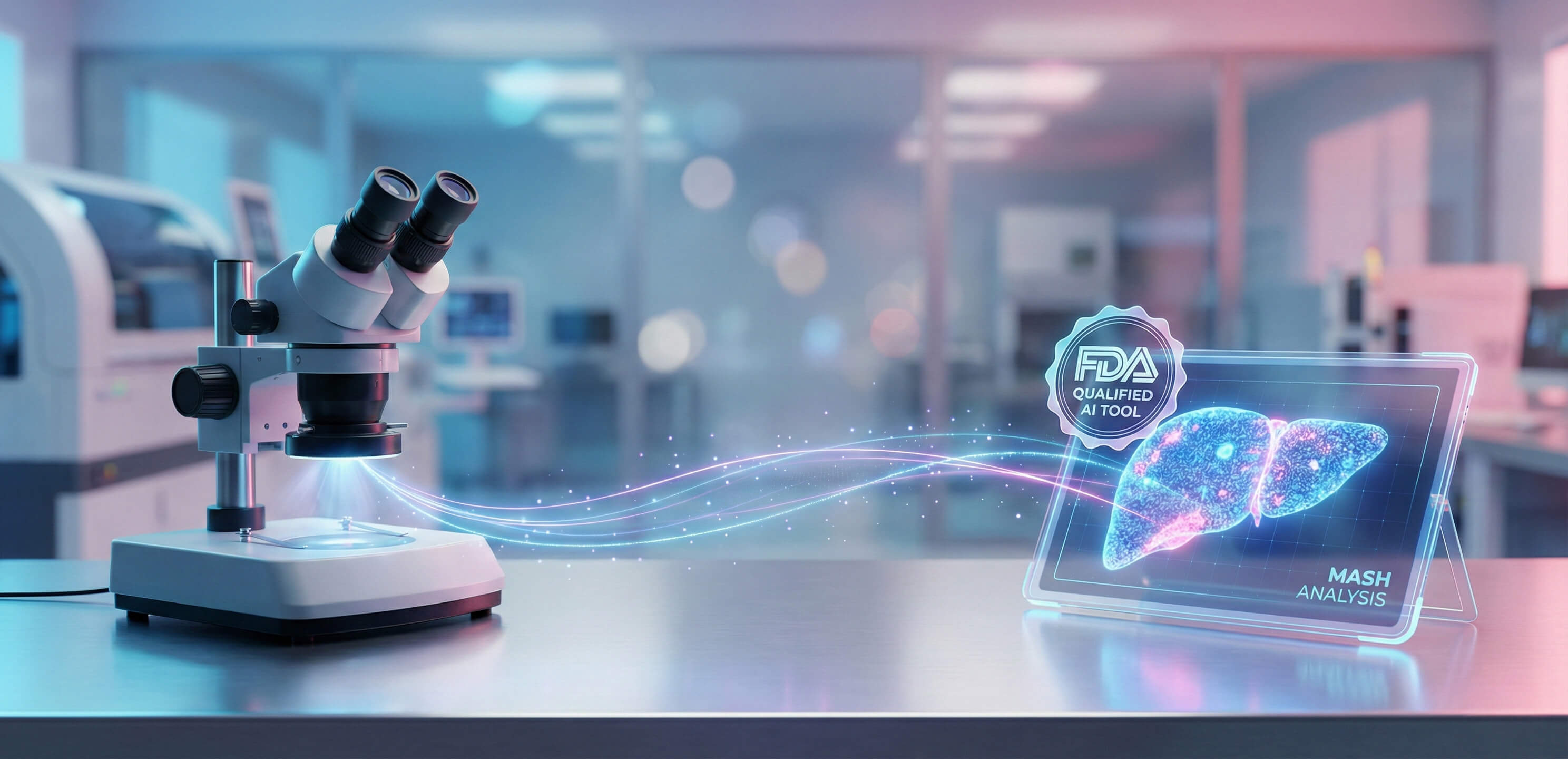
Regulatory history was made this past month. For the first time, the U.S. Food and Drug Administration (FDA) has qualified an artificial intelligence-based tool to support drug development.
The tool, AIM-MASH AI Assist (developed by PathAI), is designed to analyze liver biopsies in clinical trials for metabolic dysfunction-associated steatohepatitis (MASH).
This is not just a win for liver disease research; it is a signal that regulatory bodies are moving from "cautious observation" of AI to "validated integration." Here is what clinical operations leaders need to know about this milestone.
The Problem: The "Subjectivity Trap" in MASH Trials
MASH (formerly known as NASH) has historically been a graveyard for drug development. One of the primary culprits has been the measurement of the disease itself.
To determine if a drug is working, pathologists must look at liver biopsies under a microscope and score them on features like inflammation, ballooning, and fibrosis. This process is inherently subjective.
- High Variability: Two expert pathologists often look at the same slide and give different scores.
- Low Sensitivity: Human eyes struggle to detect subtle, quantitative changes in tissue structure over a short trial period.
- Operational Drag: The need for consensus reads (where multiple pathologists review the same slide to agree on a score) slows down trial timelines significantly.
The Solution: AIM-MASH AI Assist
The newly qualified tool acts as a "digital pathologist assistant." It uses deep learning algorithms to analyze digital pathology images and generate a standardized score based on the MASH Clinical Research Network (CRN) system.
Crucially, the FDA qualification supports a "Human-in-the-Loop" workflow. The AI does not replace the pathologist; it proposes a score, which the pathologist then reviews and confirms.
Key Benefits Validated by the FDA:
- Standardization: It reduces inter-reader variability, ensuring that a "Grade 2" fibrosis in a trial site in Boston means the same thing as a "Grade 2" in Berlin.
- Efficiency: It streamlines the workflow by potentially removing the need for multiple independent reads, accelerating the data lock process.
- Precision: In validation studies, the AI-assisted reads matched expert consensus as closely as unaided individual reviews, but with higher reproducibility.
Why "Qualification" is a Big Deal
FDA "Qualification" is different from a standard medical device clearance. It means the tool is now an FDA-endorsed method for use in any drug development program for this specific context.
Sponsors who use AIM-MASH in their trials no longer need to spend months negotiating with the FDA to prove the tool works. The regulatory debate is settled. This allows sponsors to incorporate AI endpoints into their Phase 2 and 3 protocols with confidence, knowing the data will be accepted for regulatory filings.
The Alethium Perspective
At Alethium, we see this as the beginning of Computational Histology as a standard of care in clinical research.
The qualification of AIM-MASH sets a precedent for other "subjective" endpoints—in oncology, dermatology, and neurology—to be digitized and standardized. By removing human variability from the measurement, we lower the noise in the data. Lower noise means smaller sample sizes, faster trials, and clearer signals of efficacy for life-saving drugs.